Research
The strength of Purdue's Department of
Physics is its internationally recognized research in the areas of astrophysics, condensed-matter physics, high energy
physics, geophysics, nanophysics,
nuclear physics,
sensor technology, biophysics and more.
The Department of Physics strives to involve
students in research on all the scales of nature so they can develop into
the next generation of scientists who can understand
and communicate the beauty and mystery of the world that we live in.
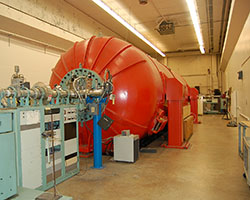
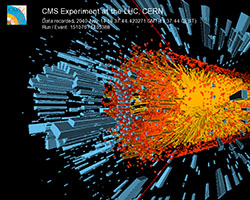
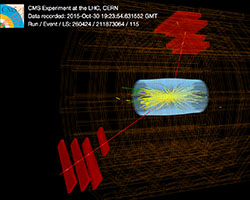
At the smallest sub-atomic scales (10-15 meters) Purdue faculty are unraveling the structure of matter using some of the most powerful particle accelerators created by man at Fermilab in Batavia, Il, CERN in Europe, and the Relativistic Heavy Ion Collider (RHIC) in New York. The high energy particle physics group is engaged in experiments at the high energy and short distance frontiers in experiments such as CDF at Fermilab and CLEO/CLEO-C at Cornell and preparations for the next generation experiment, CMS, at the Large Hadron Collider. These experiments involve probing the properties of heavy quarks and leptons and the search for new phenomena. Members of the high energy nuclear physics group are studying the deconfined state of matter known as the quark-gluon plasma, created in collisions between relativistic heavy nuclei.
Our Purdue facilities, which include clean rooms for the development and fabrication of microstructure silicon and gas detectors, are among the best in the nation. The blend of sophisticated design and fabrication of detectors, together with the analysis of frontier physics provide an ideal education for students.
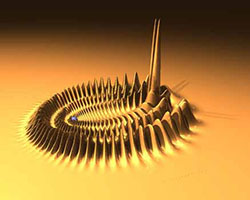
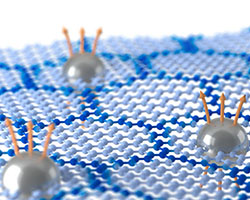
At the nano-to-micron scale (10-9 - 10-6 meters), physics department faculty and students are studying the properties of diverse systems such as the single electron transistor, small ensembles of matter and the electronic properties of macroscopic materials. In addition, there is an active research program that focuses on biological systems. Current experimental investigations include the dynamics of the heme group, photosynthetic systems using pico-second and femto-second pump-probe techniques, and computational studies of the electronic structure and mesoscopic properties of bio-molecular nanostructures.
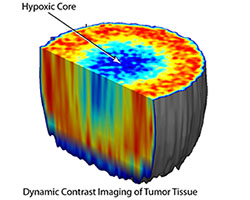
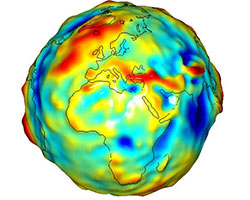
At the "everyday" scale (10-3 - 103 meters) faculty are probing the workings of gravity, "flying through" tumors, characterizing percolation in soil and rocks, and determining the ages of geological features. The Purdue Rare Isotope Measurement Laboratory (PRIME Lab) is one of only a few facilities in the nation capable of measuring very low concentrations of the natural and man-made radio-nuclides 10Be, 14C, 26Al, 36Cl, 41Ca and 129I, using accelerator mass spectrometry (AMS). Although the instruments and detection methods are those of nuclear physics, research applications are concentrated in the Earth sciences and biomedical sciences. An example is research directed at combating osteoporosis, a disease characterized by decreased skeletal mass and increased susceptibility to bone fractures. We are investigating the use of soy isoflavones as an alternative to estrogen replacement therapy by administering these supplements with 41Ca and then monitoring 41Ca excreted in the urine.
At the largest scales, the astronomical scale (1012 - 1026 meters), researchers are pursuing the answers to questions concerning the death of stars, the workings of galaxies and the super-massive black holes that power them, to the very basics of how the Universe was born and what is its ultimate fate. The astrophysics group conducts research of astrophysical objects using a multi-wavelength approach. Current research includes the use of radio-telescopes, space-based telescopes, and land-based gamma-ray telescopes located in Arizona.
An exciting new development in the Department of Physics is its selection, in partnership with ITaP (Information Technology at Purdue University) to build and operate a so-called "Tier-2 center". Tier-2 centers are at the core of empowering US universities to perform physics analysis at the LHC (Large Hadron Collider). The LHC, currently under construction at CERN, the European Organization for Nuclear Research located near Geneva, Switzerland, is the largest scientific instrument on the planet.